Meeting Action Notes: Leave with Owners, Next Steps and Open Questions
A useful meeting page helps you find the agreed next step after the conversation ends. Keep discussion notes, decisions and actions visibly separate. This original worksheet is for ordinary personal or voluntary group coordination, with an example you can adapt.
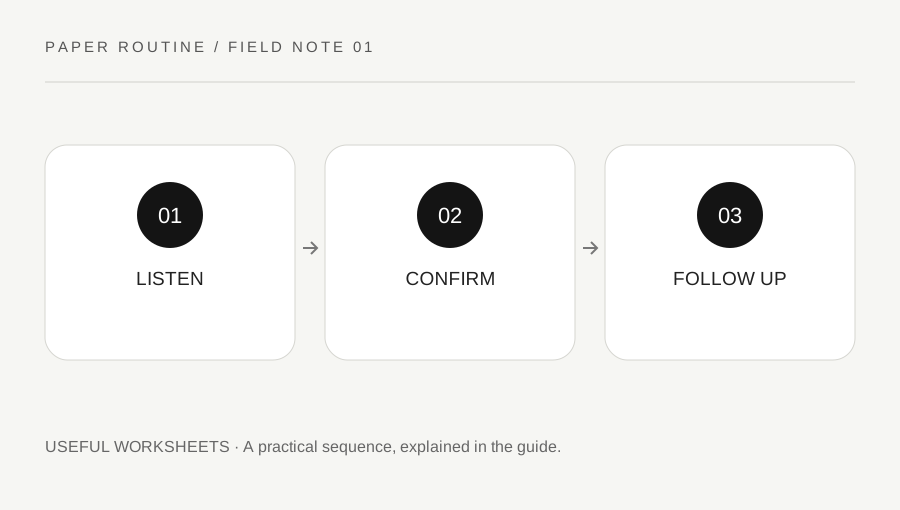
Original explanatory diagram. Examples illustrate a method or decision; they are not claims of personal testing.
Give the page a clear job
Write the meeting topic, date and purpose at the top. Leave a narrow area for questions and a larger area for notes, then reserve the bottom for agreed actions. This is an original practical layout; it is not a claim that a particular arrangement guarantees better recall. Cornell's note-taking resources provide background on organizing and reviewing notes, while this page focuses specifically on action follow-through.
Avoid attempting a word-for-word transcript when the group only needs a practical record. Capture enough context to understand an agreement later, especially where two similar options were discussed. If a formal organization requires a particular minute-taking process, use that process rather than treating a personal worksheet as its official record.
Make every action understandable on its own
Use an action verb and a visible outcome: confirm the room booking, send the revised invitation, or bring the labelled materials box. Put one action in each row. Add the agreed owner and date, leaving either field explicitly unconfirmed when the conversation has not settled it. A name beside an idea is not evidence that the person accepted responsibility.
Ask a short clarification before the group closes: who is taking this forward, and when should the next update happen? Keep a proposed deadline distinct from an agreed one. Record open questions separately so they do not appear as completed decisions. A useful action should still make sense when read by someone who did not hear the preceding ten minutes.
Work through a small group example
Imagine three neighbours arranging a community reading session. The discussion covers chairs, a room and refreshments. The note-taker writes: Sam will ask the venue whether the room is available and report back on Thursday. That is clearer than room, Sam, soon. Jo is considering borrowing chairs, but has not confirmed, so that item remains an open question.
At the close, the group checks the action rows aloud and corrects one date. The note-taker shares only the relevant agreed record through the group's usual channel. This invented example illustrates the difference between a discussion suggestion and a commitment. It does not imply that every volunteer group has the same procedures or that a worksheet can authorize someone else's work.
Review before the next conversation
After the meeting, clean up ambiguous shorthand while the context is still available. Do not quietly change the meaning of an agreement. If an important point is uncertain, ask the group to confirm it. Use the original date and a clear update note so later readers can distinguish what was agreed from what changed afterward.
At the next check-in, mark each action completed, still in progress, blocked or no longer needed, with a brief factual note. Keep an unfinished item visible without repeatedly copying the whole discussion. Where a new action replaces an old one, cross-reference the replacement. The status labels are a practical choice inspired by the broader principle of clear task states, not an official reporting standard.
Use and store the printable deliberately
Download the original blank SVG below and print it through your browser at a readable scale. It has room for purpose, notes and action rows; continue on a second labelled page if necessary. Test one copy before producing several, because printer margins and paper size differ. You can also redraw the same fields in an ordinary notebook.
Keep private personal information out of a shared meeting sheet unless it is necessary for the agreed purpose. Store the record where the intended group can find it, with a clear title and date. A worksheet offers no automatic reminders or access controls. Put any actual appointment into the calendar you use, and keep the action page as supporting context.
Your original printable
Download the original SVG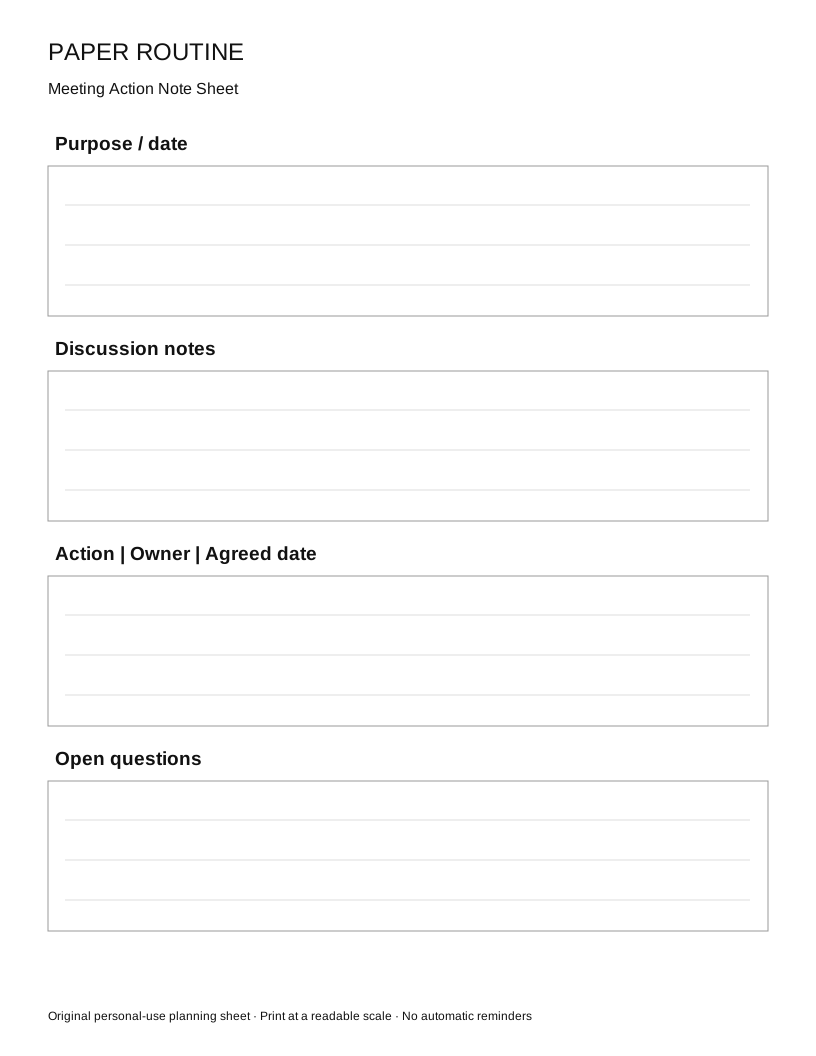
A practical checklist
Choices are saved in this browser. Reset them here or clear this site’s browser storage.
Questions that come up
Must every discussion point become an action?
No. Some points provide context or remain unresolved. Turning every suggestion into an assigned task can create commitments that nobody agreed to.
Can I use this instead of official minutes?
Only when the group permits that format. Follow any formal record-keeping requirement that applies to the organization.
What if an owner or date is unknown?
Write unconfirmed and arrange a clarification. An empty field should not be treated as an agreement.
References & scope
Background references checked on 18 October 2026. Worked examples and diagrams are original teaching material.